
Strata schemes
Strata Cleaning Services
Common property, cleaned in daylight, and reported to the committee in writing after every visit. Because the reason committees change cleaners is almost never the cleaning — it is that nobody can tell what happened, and the bin room is still awful.
- Common property only, boundary agreed in writing
- The bin room has a frequency, not a complaint threshold
- Cleaned in daylight — residents are home at night
- A written report to the committee after every visit
What is actually behind the quote
Every line here is documented. Ask, and the paperwork is in your inbox before the first shift rather than after you chase it.
- $20m public liabilityCertificate of currency on request
- Police-checked cleanersWWCC where children are on site
- No lock-in contractFixed written price within 24 hours
What does strata cleaning cover?
Clean Best cleans common property in a strata scheme: the foyer and entry glass, the mailbox bank and the intercom panel, lift cars and the call buttons on every landing, common corridors, fire stairs, the bin room including the chute mouth and surround where there is one, the basement car park, and common amenities where they exist.
Clean Best does not clean inside individual lots. Apartments, balconies and, in most schemes, garage bays are not common property and are not in scope. What is and is not common property in a particular scheme is a matter for the strata manager and the by-laws, and Clean Best agrees the boundary in writing with the committee before starting rather than assuming it.
Common areas are cleaned in daylight at agreed times, because residents are home at night. Clean Best sends the committee a written report after every visit — what was done, what was found and what was not right — and a named supervisor audits the site monthly.
- A scope per industryWritten for your venue type, not copied from the last client
- $20m public liabilityCertificate of currency before the first shift
- Sydney and NSW onlyOne depot at Seven Hills. We do not work interstate.
- Written quote in 24 hoursFixed price, no lock-in contract
The detail
Committees do not sack cleaners over dust. They sack them over the bin room and the silence.
Strata cleaning servicesare unusual because the person paying is not the person complaining. The committee signs the contract. The residents live in the building. And the committee’s entire picture of how the cleaning is going is assembled, almost exclusively, from complaints — which means the only news they ever get is bad news, arriving at random, from the angriest owner.
That is a terrible way to run a building, and it is the industry norm. Fixing it is not a cleaning problem. It is an information problem.
One thing this page will not do: tell you what is and is not common property. That is a question for your strata manager and your by-laws, and it varies. We walk it with you, we agree it in writing, and our cleaners are inducted on that boundary. What follows is what we clean and how.
The bin room, which decides everything
If a strata scheme has one persistent source of complaint, it is the bin room. It is hot, it is enclosed, it has organic waste in it, and in a building with a chute it has a chute mouth that nobody has ever cleaned. And on a startling number of strata contracts, it appears on the scope with a frequency of “as required”.
“As required” means: after somebody complains. Which means the room is unacceptable for some period before every single clean, by definition. It is a scope written to guarantee the exact outcome everybody is trying to avoid.
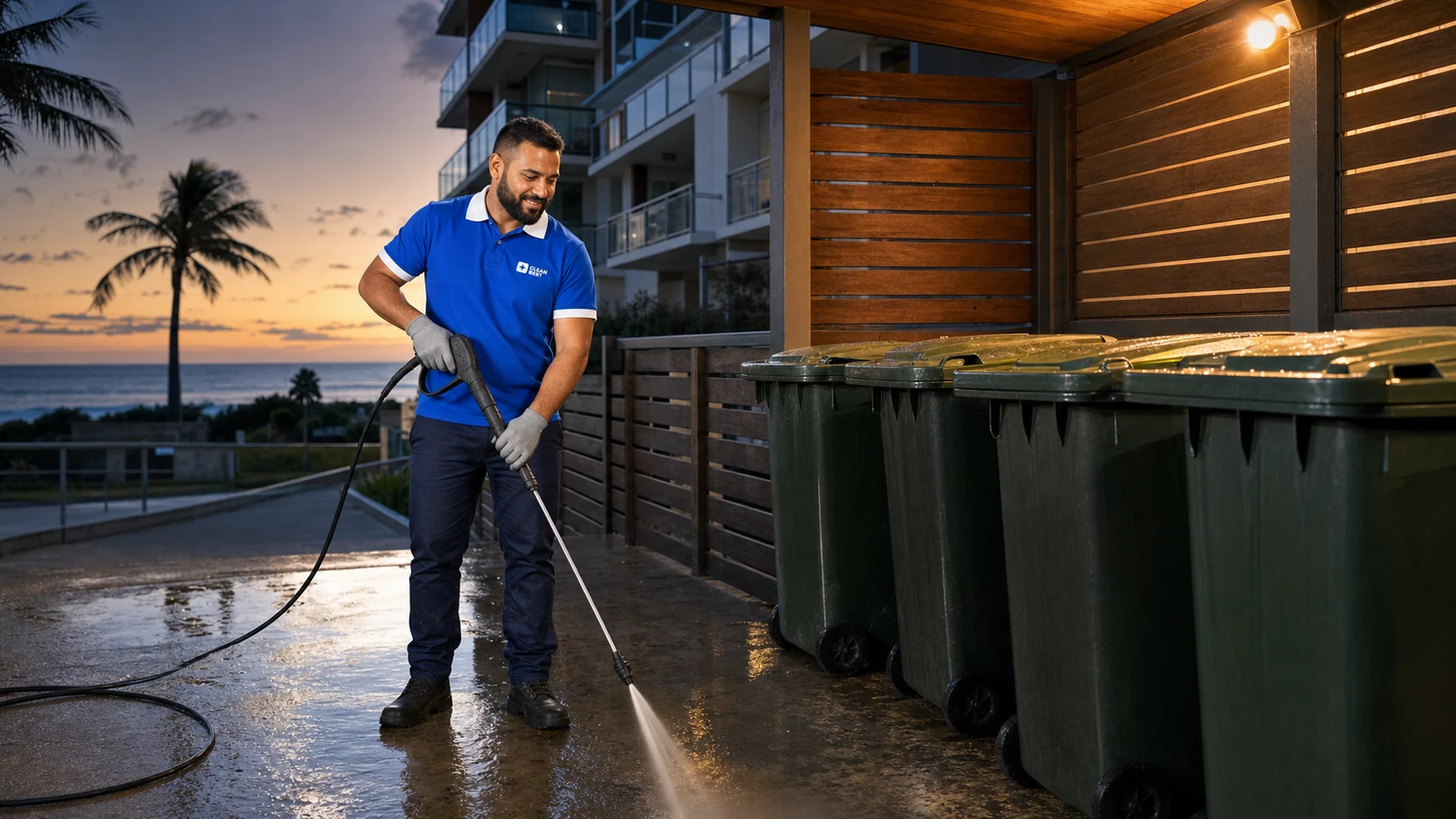
On our scopes the bin room has a written frequency. The floor. Hosing and disinfecting where there is a drain. The bin lids and the outside of the bins. The chute mouth and its surround. On a schedule, whether or not anybody has complained — which is the only version of this that ever works.
Residents are home at night
A commercial cleaning company’s instinct is to work after hours, because that is when a building is empty. A residential building is never empty. It is at its fullest at ten o’clock at night, and the people in it are on the other side of the doors you would be running a vacuum past.
Do that once and the committee will hear from every owner on that floor by morning. So common areas are cleaned in daylight, at times the committee agrees, and anything noisy is scheduled where it disturbs the fewest people. It seems obvious written down. It is broken constantly by contractors whose instincts were formed in offices.
The fire stairs, and the lift landings
Two blind spots, both for the same reason: nobody goes there, so nobody sees the state of them, so nobody puts them on a list. The fire stairs are cleaned when there is an inspection or when somebody moves out and drags a couch down them. The lift landing call buttons are pressed by every resident on every floor, every day, and are on almost no scope anywhere.
Both go on ours with a date. Fire stairs on a written rotation. Lift call buttons named floor by floor, alongside the panel in the car — because in an eight-storey building with two lifts, the panel in the car is a small fraction of the surface people actually touch.
The report is the product
This is the part that changes the relationship. After every visit the committee gets a written report against the agreed scope: what was done, what was found, and what was not right. Not a cheerful summary — the actual findings, including the things that are deteriorating and the things we could not do because a bay was occupied or a room was locked.
A named supervisor audits the building monthly against the written scope and sends that too, including the misses. Anything below standard is fixed before the next scheduled visit and it does not go on the invoice.
The point is not the paperwork. The point is that the committee finds out what is happening in their building from a document, on a schedule, instead of from an owner at 7am who has just walked past the bin room.
Call 02 5839 3012 / 0485 000 860. We will walk the common property with you and the strata manager, and the first thing we will do is agree exactly where it ends.
The difference
What a general cleaner gets wrong in a strata scheme
Four failures. The first one guarantees complaints and the fourth one starts a war between owners.
The bin room on an as-needed frequency
Which in practice means it is cleaned after somebody complains, which means it is unacceptable for some period before every clean. It is the single largest source of strata complaints and it is the most commonly under-scoped room in the building.
What we do instead: The bin room has a written frequency on the scope: floor, hosing and disinfecting where there is a drain, bin lids, the outside of the bins, and the chute mouth and surround. It happens on a schedule, not on a complaint.
Vacuuming a corridor at ten at night
Residents are home, and they are in bed on the other side of the doors you are running a vacuum past. It is a very efficient way for a committee to hear from every owner in the building on the same morning.
What we do instead: Common areas are cleaned in daylight at times agreed with the committee, and anything noisy is scheduled where it disturbs the fewest people. Residential buildings are not offices.
No report, just an invoice
The committee has no way to tell whether the contractor came, what they found, or what is deteriorating — so the only signal they ever get is a complaint from an owner. That is a terrible way to manage a building and it is the industry norm.
What we do instead: A written report against the agreed scope every visit — what was done, what was found, what was not right — plus a named supervisor auditing the site monthly and fixing anything below standard at no charge.
Doing 'favours' inside individual lots
A cleaner does a resident a small kindness inside an apartment. It becomes an expectation, then a habit, then an entitlement, and then a complaint from every other owner about work the owners corporation is paying for and only one lot is receiving.
What we do instead: Common property only. The boundary is agreed with the committee in writing before we start, and our cleaners are inducted on it. If a resident wants private work, that is a private arrangement and we say so.
What's included
What we clean in your building
A typical common-property scope. Yours is written from the walkthrough with the committee — and so is the boundary.
- Foyer: floor, entry glass, entry mats, seating and the surfaces everyone touches on the way in
- Mailbox bank, the surround, and the intercom panel and its buttons
- Lift cars: panels, mirrors, handrails, door frames, tracks and floors
- Lift call buttons on EVERY landing, floor by floor, named individually
- Common corridors: floors, skirtings, corridor ends, and the light switches nobody wipes
- Fire stairs on a written rotation with a date — handrails, treads, landings and corners
- Bin room on a written frequency: floor, hosed and disinfected where there is a drain
- Bin lids, the outside of the bins, and the chute mouth and surround where there is a chute
- Basement car park: common walkways, stairs, lift lobby, visitor bays, sweep and blow-down
- Common amenities where they exist: gym, pool surround, BBQ area, common room
- Common bathrooms where they exist; restock consumables before they run out
- Disinfect common touchpoints: door handles, push plates, handrails, intercom, gate buttons
- Report to the committee after every visit: what was done, what was found, what was not right
- Monthly supervisor audit against the written scope, including the misses
COMMON PROPERTY ONLY. Individual lots, balconies and (in most schemes) garage bays are not in scope. The boundary is agreed with the committee in writing before we start and our cleaners are inducted on it. Basement slab machine-scrubbing, oil-stain treatment, carpet extraction and hard-floor programs are periodic and quoted separately, because they need bays cleared and that needs the committee to organise residents. We do not perform height-access work.
Access
When a strata building can actually be cleaned
It is a residential building. It is never empty, and it is fullest at exactly the hour a commercial cleaner would want to be there.
| Area | When we clean it | Why that window |
|---|---|---|
| Foyer, lifts, corridors | Daylight, at agreed times | Residents are home at night. Running a vacuum past bedroom doors at ten in the evening is how committees get twenty emails at once. |
| Bin room | Written frequency, not on complaint | It is the biggest source of complaints in most schemes, and it is only ever solved by putting it on a schedule. |
| Fire stairs | Rotation, with a date | Nobody uses them, so nobody cleans them — until an inspection, a move-out, or somebody actually has to use them. |
| Basement car park | Regular sweep and blow-down; scrub is periodic | Machine-scrubbing the slab needs the bays cleared, which needs the committee to organise the residents. That is a project, not a visit. |
| Committee report | Every visit, in writing | So the committee learns what is happening in the building from a document rather than from an angry owner. |
Pricing
A strata scheme is quoted by the levels and the lift landings, not the lot count
What drives the work is the number of levels, the number of lift landings, the length of the common corridors, whether there is a basement, and the state of the bin room. Lot count tells you almost nothing.
Small scheme
A low-rise block: a foyer, one lift or none, a stairwell, a bin area and a small car park.
- Common property only, boundary agreed with the committee in writing
- Bin area on a written frequency, not on complaint
- Foyer, entry glass, mailboxes and intercom panel every visit
- One named cleaner the residents come to recognise
Fixed price, in writing, before anyone starts.
Mid-rise building
Multiple levels, one or more lifts, long common corridors, a bin room with a chute, a basement car park.
- Lift call buttons on every landing, named floor by floor
- Bin room: floor, hosing, bin lids, chute mouth and surround on schedule
- Fire stairs on a written rotation with a date
- Written report to the committee every visit, plus a monthly supervisor audit
Fixed price, in writing, before anyone starts.
Large or multi-building scheme
A high-rise, or a scheme across several buildings with shared amenities and a large basement.
- One scope design applied consistently across every building
- Periodic programs: basement slab scrub, carpet extraction, entry mat work
- One supervisor, one site register and one consolidated invoice
- Insurance certificates and safety data sheets supplied to the committee up front
Fixed price, in writing, before anyone starts.
Free walkthrough of your premises, then a written quote within 24 hours.
How it works
How we take over a strata clean
Four steps, and the first thing we agree is where common property ends.
- 1
Ring us with the committee or the strata manager
Call 02 5839 3012. How many levels, how many lift landings, whether there is a chute and a basement, and where the complaints are actually coming from.
- 2
We walk the common property with you
And we agree the boundary as we go: what is common property in this scheme, what is not, and what we will therefore never touch.
- 3
A scope, and a reporting commitment
Within 24 hours: one fixed figure, the frequencies, the fire-stair rotation with dates, and the written report the committee will get after every visit.
- 4
The same cleaner, and a monthly audit
Inducted on the building and the boundary, starting on the agreed date, with a named supervisor auditing monthly and fixing anything below standard at no charge.
FAQ
Strata cleaning questions
What committees and strata managers ask us before they change contractors.
What is included in strata cleaning services?
Clean Best cleans common property: the foyer and entry glass, the mailbox bank and the intercom panel, lift cars and the call buttons on every landing, common corridors, fire stairs, the bin room, the basement car park and the common bathrooms or amenities where they exist. What is and is not common property in your scheme is a question for your strata manager and your by-laws, and we agree the boundary in writing with the committee before we start rather than guessing at it.
Do you clean inside the apartments?
No. Clean Best cleans common property only. Individual lots, balconies and, in most schemes, garage bays are not common property and are not in our scope. If a resident wants their own apartment cleaned that is a separate private arrangement and not something the owners corporation is paying for — and we will say so rather than quietly do a favour that becomes an expectation and then a complaint.
What actually happens in the bin room?
It is the single biggest source of complaint in most schemes and it is the room most often under-scoped. Clean Best cleans the bin room floor, hoses and disinfects it where there is a drain, cleans the bin lids and the outside of the bins, cleans the chute mouth and the surround where there is a chute, and puts the whole room on a written frequency. A bin room that is cleaned when somebody complains is a bin room that will generate complaints indefinitely.
Do you report to the committee?
Yes, and it is one of the reasons committees change contractors to us. Clean Best sends a written report against the agreed scope — what was done, what was found, and what was not right — rather than leaving the committee to work out from the invoice whether anybody came. A named supervisor audits the site monthly, and anything below standard is fixed before the next scheduled visit and does not appear on the invoice.
When do you clean a strata building?
In daylight, in most schemes. Residents are home at night and cleaning a corridor at ten in the evening means running a vacuum past bedroom doors — which is one of the fastest ways for a committee to hear from every owner in the building at once. Foyers, lifts, corridors, stairs, bins and car parks are done during the day at times agreed with the committee, and anything noisy is scheduled where it disturbs the fewest people.
Can you handle a car park?
Yes — sweeping, blowing down, cleaning the common walkways and stairs, the lift lobby at basement level and the visitor bays. Machine-scrubbing a basement slab and dealing with oil staining is a periodic program and is quoted separately, because it needs the bays cleared and that needs the committee to organise the residents. We will tell you what it involves rather than promising a clean slab and then explaining afterwards why it did not happen.
What does strata cleaning cost?
Clean Best does not publish a price. Strata cost follows the number of levels, the number of lift landings, the length of the common corridors, whether there is a basement car park, and how bad the bin room situation is — not the number of lots. We walk the building with the committee or the strata manager, agree the common-property boundary in writing, and confirm a fixed figure within 24 hours.
Keep exploring
Other premises we write a dedicated scope for
A mixed-use building is several scopes. One supervisor, one report, one invoice.
Book strata cleaning services the committee can actually see
Free walkthrough with the committee or the strata manager. Written report after every visit. Call 02 5839 3012 / 0485 000 860.