
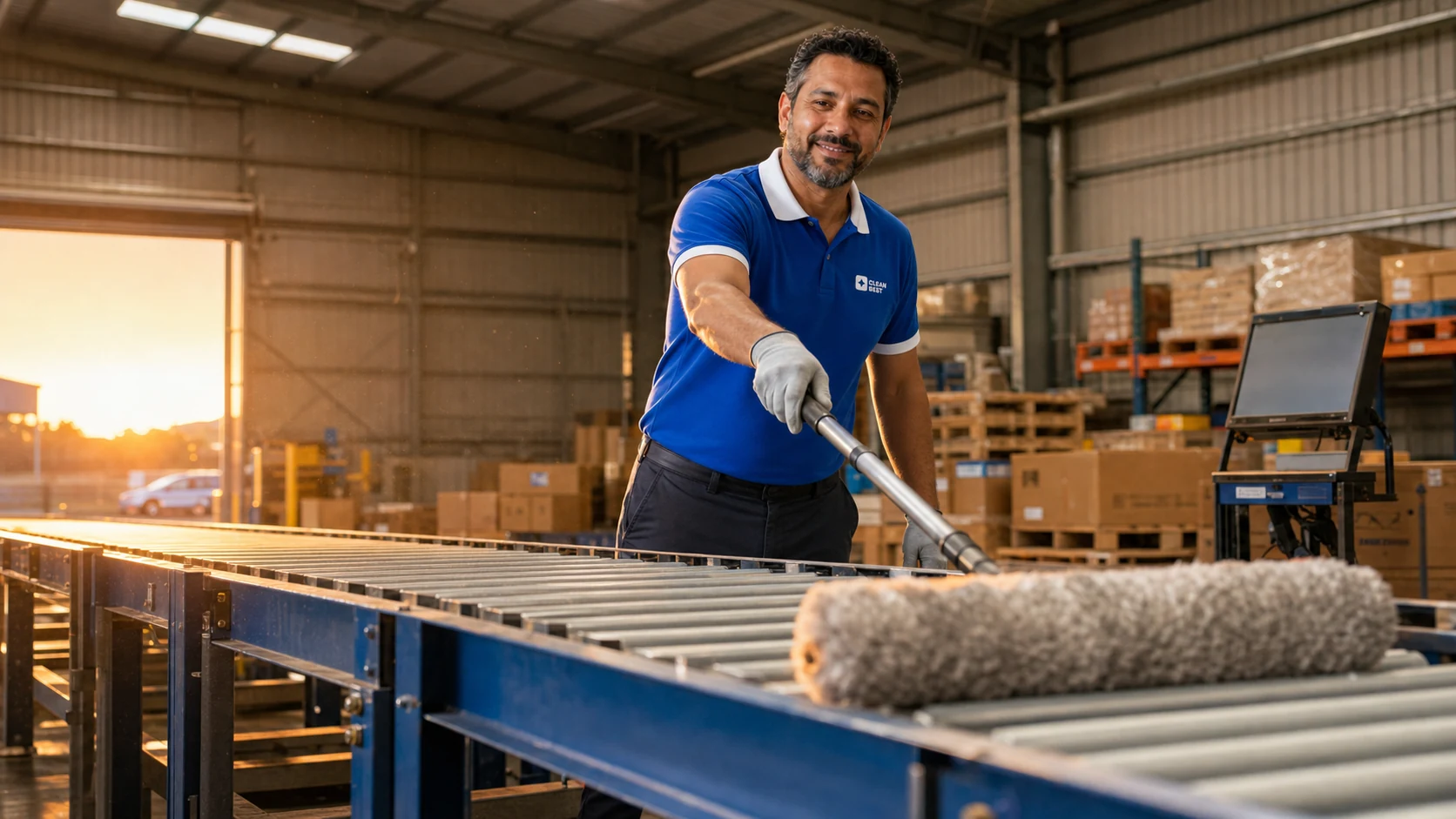
Warehouses
Warehouse Cleaning Services
A working warehouse is a live site with forklifts in it, and that changes everything about how it gets cleaned. We take the aisles you are not working, in a sequence your supervisor agrees, and we move as the operation moves.
- Worked around your pick runs, never through them
- Dust captured with filtration, never swept into the stock
- Line-marking kept visible — and wear reported to you
- The attached office gets an office scope, not a warehouse one
What is actually behind the quote
Every line here is documented. Ask, and the paperwork is in your inbox before the first shift rather than after you chase it.
- $20m public liabilityCertificate of currency on request
- Police-checked cleanersWWCC where children are on site
- No lock-in contractFixed written price within 24 hours
How is a working warehouse cleaned?
Clean Best cleans operating warehouses around the pick and dispatch runs rather than through them: aisles are taken in a sequence agreed with the site supervisor, and the crew moves as the operation moves. Wet areas are signed and controlled and are never left across a live traffic lane, because a wet concrete floor under a forklift is a hazard.
The work covers machine-scrubbing aisles and traffic lanes, dusting racking uprights and beam faces at heights reachable from the floor, sweeping and detailing the dock and its apron, keeping line-marking and floor signage visible, and cleaning pick faces and pack benches. Dust is captured with filtered sweepers, scrubbers and vacuums rather than swept, because sweeping a concrete slab puts the dust onto the stock and the racking.
The office and amenities attached to a warehouse are cleaned to an office standard under a separate scope. Clean Best does not perform height-access work, so high-level racking and anything requiring an elevated work platform are outside the scope and are named as exclusions.
- A scope per industryWritten for your venue type, not copied from the last client
- $20m public liabilityCertificate of currency before the first shift
- Sydney and NSW onlyOne depot at Seven Hills. We do not work interstate.
- Written quote in 24 hoursFixed price, no lock-in contract
The detail
You cannot clean a warehouse. You can only clean the part of it that is not being used.
Warehouse cleaning services fail for a reason that has nothing to do with cleaning. They fail because the contractor treats the warehouse as a building, and it is not a building. It is an operation that happens to have a roof, and at any given moment most of it is unavailable — because there is stock in it, or a forklift in it, or a truck backed onto it.
Every warehouse scope that has ever gone wrong went wrong at exactly that point: it was written as though the floor would be empty, and the floor is never empty.
The traffic is the constraint, and it is not negotiable
A wet concrete slab under a live forklift is not a minor inconvenience. It is a genuine hazard, and so is a pedestrian walking a wet lane between racking. A cleaner who walks onto a working floor with a mop bucket and no plan has made your site more dangerous, not cleaner.
So we do not improvise it. We agree an aisle sequence with your supervisor — which aisles are ours tonight, which ones we take next, where we are allowed to be while a pick run is on — and we move as the operation moves. Wet areas are signed and controlled and never left across a live lane. It is slower than a contractor who promises to “work around your traffic” without any specifics, and that contractor has not done this before.
Do not sweep a concrete slab
A broom on a big concrete floor does not remove dust. It launches it. It goes into the air, drifts across the aisle, and settles on the racking, the stock, the pack benches and every surface that was cleaned an hour ago. If your site is food-adjacent or pharma-adjacent, it settles on things that should not have dust settling on them.
Dust has to be captured. Filtered sweepers and scrubbers, ride-on or walk-behind depending on the aisle width, and vacuuming rather than sweeping wherever the dust actually matters. It is the difference between a floor that is clean and a warehouse that is clean, and the two are not the same thing.
The line-marking, which nobody thinks is a cleaner’s problem
Traffic lanes, pedestrian walkways and floor signage exist to be seen. Grime progressively obscures them, and it does it slowly enough that nobody on the site notices the day they stopped being visible. Then somebody walks a lane they should not have walked.
So keeping line-marking visible is on the scope. And — this is the useful part — we tell you when a line is worn through rather than dirty, because at that point no amount of scrubbing brings it back and it needs paint. That is a thirty-second observation from someone who is on the floor every week, and it is worth more than most of what a cleaning contractor will tell you.
Two scopes on one site
Almost every warehouse has an office on the front and a smoko room somewhere in the middle, and almost every warehouse cleaning contract covers both under one scope. The result is entirely predictable: the slab gets an office-grade clean, which does nothing to concrete, and the office and the smoko room get a warehouse-grade clean, which is why the smoko room is always — always — the worst room on the site.
They are different jobs. On our scopes they are two documents. The slab is machined, the racking is rotated, the dock is detailed. The office, the smoko room and the amenities are cleaned to an office standard by somebody who knows the difference, and it is written that way so nobody has to work it out at eleven at night.
What we will not do
We do not do height-access work. Anything needing an elevated work platform, and high-level racking above what can be safely reached from the floor, is outside our scope. It is specialist work, and we name it as an exclusion on the quote rather than leaving the top three beams dusty and hoping you do not look up.
Call 02 5839 3012 / 0485 000 860. We will walk the site in hi-vis, during a shift, with the forklifts moving — because that is the only version of your warehouse that tells us how it can actually be cleaned.
The difference
What a general cleaner gets wrong in a warehouse
Four failures. The second one is a safety incident waiting to happen and the third is invisible until somebody gets hurt.
Sweeping a concrete slab with a broom
You have not removed the dust, you have launched it. It settles on the stock, the racking, the pack benches and every surface that was just cleaned. In a food-adjacent or pharma-adjacent facility, that is not a housekeeping issue.
What we do instead: Dust is captured, not moved: sweepers and scrubbers with proper filtration, and vacuuming rather than sweeping wherever the dust actually matters.
Wet floors left in a live traffic lane
A wet concrete floor under a forklift is a genuine hazard. So is a pedestrian walking a wet walkway between racking. A cleaner who does not think about the traffic is creating a safety incident, not preventing one.
What we do instead: We take the aisles you are not working, in a sequence agreed with your supervisor, and we move as the operation moves. Wet areas are signed and controlled, and never left across a live lane.
Cleaning the warehouse and the office with one scope
The warehouse gets an office-grade clean, which is useless on a concrete slab, and the office and smoko room get a warehouse-grade clean, which is why the smoko room is invariably the worst room on the site.
What we do instead: Two scopes on one site. The slab is machined, the racking is on a rotation, and the attached office and amenities are cleaned to an office standard by somebody who knows the difference.
Nobody watches the line-marking
Traffic lanes and pedestrian walkways get progressively obscured by grime until they are no longer doing the job they exist to do — and it happens slowly enough that nobody on site notices the day it stops being visible.
What we do instead: Line-marking and floor signage are kept clean enough to be seen, and we tell you when a line is worn through rather than dirty, because at that point it needs paint and not a scrubber.
What's included
What we clean in your warehouse
A typical scope for a live operating site. Yours is written from the walkthrough — this is the shape it usually takes.
- Machine-scrub aisles and traffic lanes in a sequence agreed with your supervisor
- Capture dust with filtered sweepers and scrubbers; vacuum rather than sweep where dust matters
- Keep traffic lanes, pedestrian walkways and floor signage visible; report worn-through lines
- Dust racking uprights and beam faces at floor-reachable heights, on a written rotation
- Clean accessible pick faces and the front edge of pick bays
- Sweep and detail the dock, the dock levellers and the apron immediately outside
- Clean pack benches, packing stations, tape dispensers and scanner cradles
- Empty and clean the waste and recycling areas; clear stretch wrap, strapping and cardboard
- Clean the goods-in and goods-out desks, screens and touchpoints
- Amenities: toilets, basins, mirrors, showers where present; restock consumables
- Smoko room and staff room to an OFFICE standard: benches, sink, fridge, microwave, tables, bins
- Attached office to an office standard: desks, kitchen, glass, floors, touchpoints
- Entry, reception and the visitor sign-in area
- Periodic: full slab scrub on a shutdown, stocktake day or quiet weekend
We do not perform height-access work. High-level racking and anything requiring an elevated work platform are outside this scope and are named as exclusions on the quote. Hi-vis, site induction, SWMS and safety data sheets are provided before the first shift, not after they are asked for.
Access
When each part of a warehouse can actually be cleaned
Most of the site is unavailable most of the time. The scope is built around what is genuinely accessible, in a sequence your supervisor signs off.
| Area | When we clean it | Why that window |
|---|---|---|
| Aisles and traffic lanes | Around your pick and dispatch runs | We take the aisles you are not working, in a sequence agreed with your supervisor, and move as the operation moves. |
| Dock and apron | Between dispatch windows | The dock is the busiest and dirtiest surface on the site, and it can only be done when a truck is not on it. |
| Racking uprights and beam faces | Rotation, at floor-reachable heights | It is a slow job and it does not need doing weekly. It needs doing on a cycle, with a date. |
| Office, smoko room, amenities | Their own scope, their own schedule | They are an office. Cleaning them to a warehouse standard is why the smoko room is always the worst room on site. |
| Full slab scrub | A shutdown, a stocktake day or a quiet weekend | Doing the whole floor properly needs the aisles clear. On a live site that means picking a day, not squeezing it in. |
Pricing
A warehouse is quoted from what we can actually reach, not the lease area
What drives the cost is the floor we can genuinely machine, how much of the site is accessible at once, the racking, the state of the slab and the frequency — not the total footprint.
Single unit
A light industrial unit: a modest slab, some racking, a dock, and an office at the front.
- Aisles and traffic lanes machine-scrubbed on the agreed frequency
- Dock and apron swept and detailed between dispatch windows
- Attached office and amenities cleaned to an office standard
- Hi-vis, site induction, SWMS and safety data sheets before the first shift
Fixed price, in writing, before anyone starts.
Working warehouse
A live pick-and-pack operation with real forklift traffic, substantial racking and a busy dock.
- Aisle sequence agreed with your supervisor and worked around the operation
- Racking uprights and beam faces on a written rotation
- Line-marking and floor signage kept visible; wear reported to you
- Named supervisor and a written monthly audit against the scope
Fixed price, in writing, before anyone starts.
Distribution centre or multi-unit
A large site, several units, or an operation that runs across more than one shift.
- Crew sized to the shift pattern, not to a nine-to-five roster
- Full slab scrub scheduled into a shutdown, stocktake day or quiet weekend
- One supervisor, one site register and one consolidated invoice
- Insurance certificates and safety documentation supplied up front
Fixed price, in writing, before anyone starts.
Free walkthrough of your premises, then a written quote within 24 hours.
How it works
How we take over a warehouse clean
Four steps, and the walkthrough is in hi-vis with the forklifts running.
- 1
Ring us and describe the operation
Call 02 5839 3012. The slab area, the racking, the dock, the shift pattern, and — the one that shapes everything — when the forklifts are moving.
- 2
We walk it during a shift
With the operation running, in hi-vis, so we can see the real traffic. A warehouse on a Sunday tells you nothing about how it can actually be cleaned.
- 3
A scope, and a traffic plan
Within 24 hours: one fixed figure, the aisle sequence, the racking rotation, and a separate office scope. Plus SWMS and safety data sheets.
- 4
The same inducted crew
Site-inducted, in your PPE, following your traffic rules, with a supervisor auditing the site monthly against the written scope.
FAQ
Warehouse cleaning questions
What operations and site managers ask us before they change contractors.
What is included in warehouse cleaning services?
Clean Best machine-scrubs the aisles and traffic lanes, dusts racking uprights and beams, sweeps and details the dock and the apron immediately outside it, keeps line-marking and floor signage visible, and cleans the pick faces, the pack benches and the amenities. The office and the smoko room attached to the warehouse are cleaned to an office standard, because they are an office — one scope does not stretch across both, and pretending it does is how the smoko room ends up disgusting.
Can you clean while the warehouse is operating?
Yes, and it is usually the only way. Clean Best works around your pick, pack and dispatch runs rather than through them: we take the aisles you are not working, in a sequence agreed with your supervisor, and we move as the operation moves. A wet floor under a live forklift is a genuine hazard, not an inconvenience, so we do not create one — and a contractor who says they will just work around the traffic without a plan has not done this.
Why does line-marking matter to a cleaner?
Because faded or obscured line-marking stops doing the job it exists for, and grime is what obscures it. Clean Best keeps traffic lanes, pedestrian walkways and floor signage clean enough to be seen, and tells you when a line is worn through rather than dirty — because at that point it needs repainting and no amount of scrubbing will bring it back. It is a small thing and it is one of the most useful things a cleaner in a warehouse can do.
Do you clean the racking?
The uprights, the beam faces and the accessible pick faces, yes — on a rotation, at heights we can reach safely from the floor. We do not do height-access work: anything requiring an elevated work platform or working at height is outside our scope and we will name that exclusion rather than quietly leave the top three beams dusty and hope. High-level racking dusting is a specialist job and we will tell you it is.
What do you do about dust in a warehouse?
Capture it rather than move it. Sweeping a big concrete floor with a broom aerosolises dust straight onto the stock, the racking and everything that was just cleaned — including, in a food or pharma-adjacent facility, onto things that should not have dust on them. Clean Best uses ride-on or walk-behind sweepers and scrubbers with proper filtration, and vacuums rather than sweeps where the dust matters.
Do your cleaners wear PPE and follow our site rules?
Yes. Clean Best cleaners on a warehouse site wear hi-vis and the PPE your site requires, are inducted on your site before their first shift, and follow your traffic management rules — because they are your rules and they exist for a reason. We provide SWMS and safety data sheets before we start, not after your safety manager asks for them twice.
What does warehouse cleaning cost?
Clean Best does not publish a price. Warehouse cost is driven by the floor area we can actually machine, how much of the site is accessible at any one time, the amount of racking, the state of the slab and the frequency you need — not by the total footprint on the lease. We walk the site during an operating shift and confirm one fixed figure in writing within 24 hours.
Keep exploring
Other premises we write a dedicated scope for
Run a warehouse and an office and a retail front? Three scopes, one supervisor, one invoice.
Book warehouse cleaning services that work around the forklifts
Free walkthrough in hi-vis, during an operating shift. Aisle sequence agreed with your supervisor. Call 02 5839 3012 / 0485 000 860.